Published on September 29, 2026
Lap 3 tells you nothing six weeks later. "The hill" tells you everything. How lap naming works in TiCaNo Stopwatch v1.7.0 — where the names travel, how to correct the record, and why the same three taps work for a Saturday morning as well as a set of intervals.
Read more →

Published on September 20, 2026
In October 1884, 41 delegates from 25 nations met in Washington to pick one zero for the whole world. The vote was 22 to 1 — and one of the two countries that abstained held out for 27 years.
Read more →
Published on September 16, 2026
Your thumb takes about 200 milliseconds. Your phone's screen adds 100 more. A guide to timing things well anyway — what the numbers mean, which errors cancel, and which ones quietly don't.
Read more →
Published on September 14, 2026
Cooking, practising, training, timing an experiment, logging a work session — what each one looks like in TiCaNo, feature by feature, boundary by boundary. No countdown promises: the app times up, and that turns out to be the point.
Read more →

Published on September 12, 2026
Until 2008, the official style manual of the United States government said 12 a.m. meant noon. It had it backwards, or forwards — and the bodies that have ruled since all agree on one thing: don't write it.
Read more →
Published on September 10, 2026
00:04.2137 — that last digit is real, not padding. It is also not an accuracy claim. The difference between resolution, precision and accuracy, told through our own app's code.
Read more →

Published on September 8, 2026
In 2018, every mains-powered clock in Europe lost six minutes because the grid drifted by four thousandths of a hertz. No phone noticed. The difference is correction — and the correction is also the one thing that can touch a running stopwatch.
Read more →
Published on September 7, 2026
The energy savings round to zero, the heart-attack spike is real but almost always misquoted, and the sleep-medicine consensus recommends the opposite of what the US House just voted for. What the studies actually measured.
Read more →

Published on September 5, 2026
In June 1955 the steadiest timekeeper on Earth began ticking — and nothing steady enough to check it against existed. So it was tied to Greenwich, then to the Moon, and finally defined.
Read more →
Published on September 4, 2026
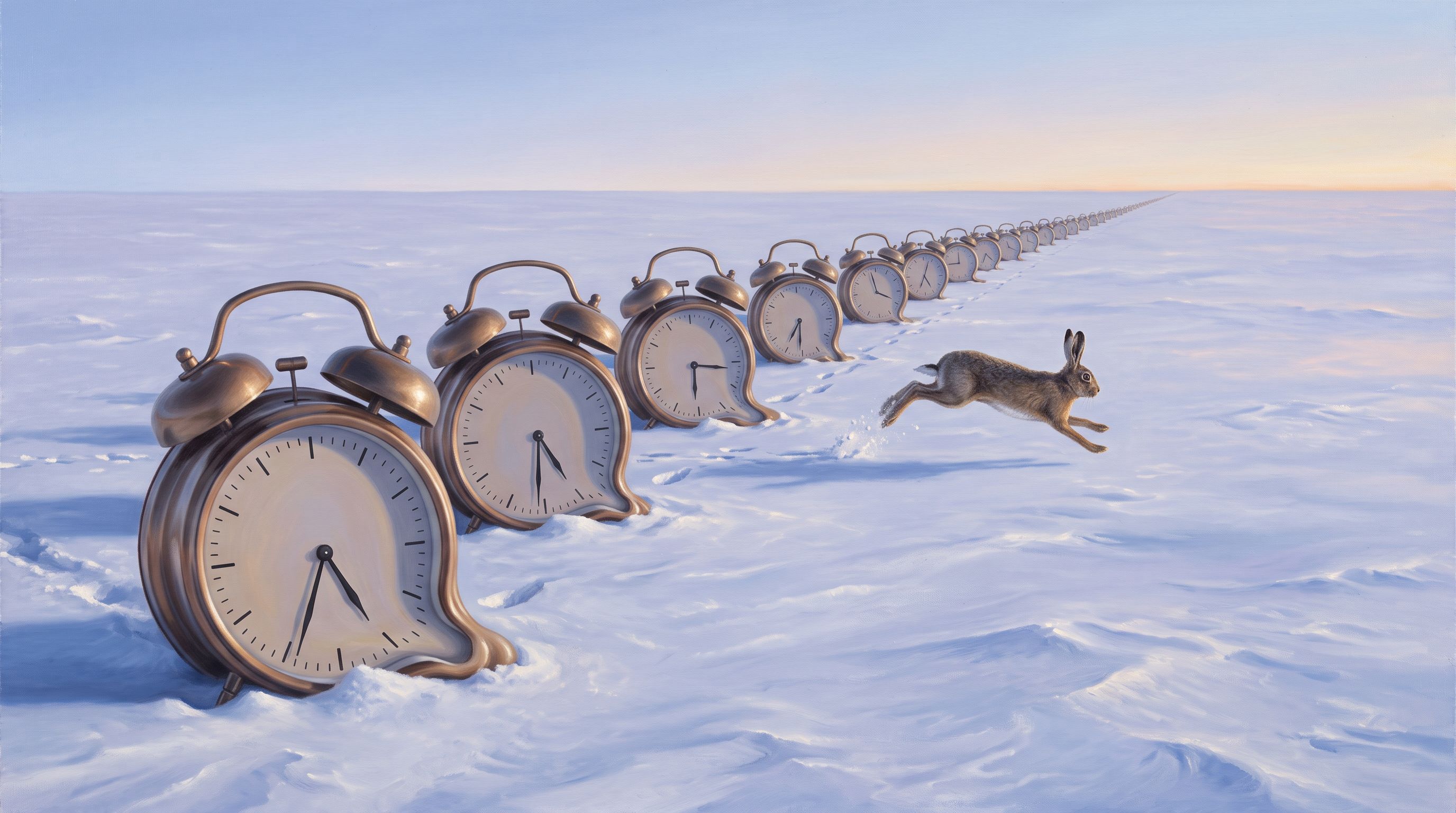
In Kashgar, the sun can reach its highest point at ten past three in the afternoon. That is not astronomy — it is politics, and once you see it, the whole map of time makes sense.
Read more →